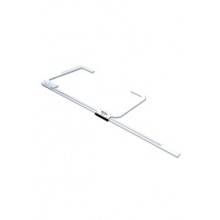
The Large Bone Caliper is a precision anthropometric measuring instrument designed for assessing body dimensions related to growth, development, biomechanics, and movement analysis. Constructed from lightweight yet durable aluminium, it provides accurate and repeatable measurements for a wide range of clinical, research, and sports science applications.
With a measuring range of 0 to 60 cm and graduations of 0.1 cm, the caliper is ideal for measuring larger skeletal dimensions such as shoulder width, chest depth, and long bone lengths. A spring-loaded ball bearing mechanism within the sliding C-shaped arm ensures smooth operation and precise positioning for reliable measurements.
Typical Applications
- Growth and development assessment in children
- Anthropometric studies
- Sports science and athlete profiling
- Motion and biomechanical analysis
- Human performance research
- Ergonomic assessments
- Clinical and rehabilitation studies
- Educational and university research programs
Common Measurements
- Shoulder width (biacromial breadth)
- Chest depth
- Femur length
- Tibia length
- Humerus length
- Other skeletal and body dimensions
Key Features
- Measurement range: 0 to 60 cm
- Resolution: 0.1 cm
- Durable aluminium construction
- Spring-loaded ball bearing for accurate positioning
- Sliding C-shaped arm design
- Lightweight and easy to use
- Accurate and repeatable measurements
- Suitable for clinical, educational, and research environments
Benefits
- Supports accurate anthropometric assessments
- Ideal for tracking growth and development
- Assists with biomechanical and motion analysis studies
- Provides reliable skeletal dimension measurements
- Robust design for long-term professional use
Typical Users of the Large Bone Caliper
The Large Bone Caliper is widely used by professionals involved in anthropometry, human movement analysis, growth assessment, and body measurement research. Its ability to accurately measure skeletal dimensions makes it a valuable tool across a range of disciplines.
Anthropometrists
Use the caliper to measure body dimensions such as:
- Shoulder width (biacromial breadth)
- Chest depth
- Long bone lengths
- Skeletal frame size
These measurements are often used in population studies and body composition assessments.
Researchers & Academics
Universities and research institutions use the Large Bone Caliper for:
- Human growth and development studies
- Anthropometric research
- Biomechanical investigations
- Sports performance research
- Ergonomic studies
Paediatricians & Child Development Specialists
The caliper helps monitor:
- Physical growth
- Skeletal development
- Proportional body changes during childhood and adolescence
Sports Scientists
Used to assess body structure and skeletal dimensions of athletes, aiding in:
- Athlete profiling
- Talent identification
- Performance research
- Training program development
Biomechanists & Motion Analysis Specialists
Measurements of limb lengths and body dimensions are used to:
- Develop biomechanical models
- Analyse movement patterns
- Improve motion capture accuracy
- Study human performance
Physiotherapists & Rehabilitation Professionals
The caliper may be used to document physical measurements and body proportions as part of rehabilitation and functional assessment programs.
Ergonomists
Use anthropometric measurements to design:
- Workstations
- Safety equipment
- Vehicles
- Consumer products
- Workplace environments
Common Environments
- Universities and research laboratories
- Sports science institutes
- Hospitals and rehabilitation centres
- Paediatric clinics
- Ergonomic consulting firms
- Human performance laboratories
Key Benefits for Users
- Accurate skeletal dimension measurements
- Ideal for growth and development monitoring
- Supports biomechanical and anthropometric research
- Durable, lightweight aluminium construction
- Reliable and repeatable results
Ensuring Accuracy in Bone Length Measurements
Accurate bone length measurements are essential for anthropometric studies, growth assessment, biomechanics, and clinical evaluations. Consistency in technique is often more important than the actual measuring instrument.
Use Clear Anatomical Landmarks
The most important factor is identifying and consistently using the same bony landmarks for every measurement.
- Palpate and locate landmarks carefully.
- Follow an established measurement protocol.
- Document the landmarks used so future measurements can be replicated.
Position the Subject Correctly
Body position can significantly affect results.
- Ensure the subject is relaxed and maintains a standardised posture.
- Keep joints in the prescribed position for the measurement being taken.
- Avoid movement during measurement.
Align the Caliper Properly
The caliper should follow the natural axis of the bone being measured.
- Position the caliper tips directly over the selected landmarks.
- Avoid angling or twisting the instrument.
- Ensure the measuring arms make firm contact without excessive pressure.
Apply Consistent Pressure
Excessive force can alter positioning and reduce measurement accuracy.
- Use gentle, consistent pressure.
- Allow the spring-loaded mechanism to contact the landmarks naturally.
- Avoid compressing soft tissue unnecessarily.
Take Multiple Measurements
A single measurement may be influenced by positioning or operator error.
- Take at least two measurements.
- If results differ significantly, repeat the measurement.
- Calculate an average value when required by your protocol.
Use the Same Examiner
When monitoring growth or conducting longitudinal studies, consistency improves when the same person performs the measurements.
- Reduces variability between operators.
- Improves comparability over time.
- Enhances reliability in research and clinical settings.
Regularly Check Equipment
To maintain measurement integrity:
- Inspect the caliper for damage or wear.
- Ensure the sliding arm moves smoothly.
- Verify scale readability and accuracy.
- Store the instrument in a protective case when not in use.
Record Results Immediately
Good data recording practices help prevent errors.
- Record measurements immediately after taking them.
- Use consistent units (typically centimetres).
- Note the side of the body measured and the measurement protocol used.
Best Practice Summary
For the most accurate bone length measurements:
✅ Use clearly defined anatomical landmarks
✅ Standardise subject positioning
✅ Align the caliper correctly
✅ Apply consistent pressure
✅ Repeat measurements when necessary
✅ Use the same examiner whenever possible
✅ Maintain and inspect equipment regularly
✅ Record results carefully and consistently
Following these principles will help ensure reliable, repeatable measurements for growth studies, biomechanical analysis, sports science, and clinical assessments.
Choose S.I. Instruments for precision you can trust, compliance you can rely on, and service that delivers confidence.