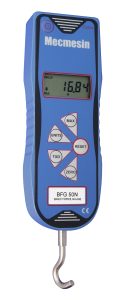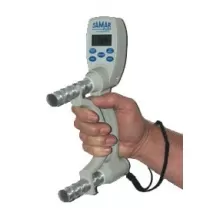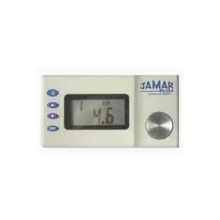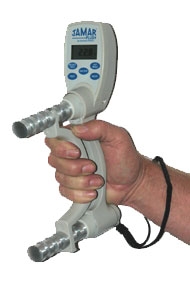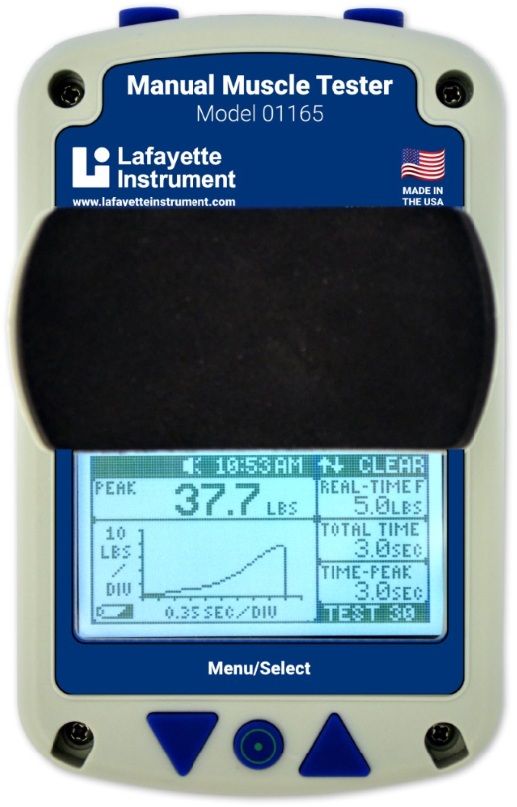
The Lafayette Hand-Held Dynamometer (HHD) System 01165 is a portable instrument designed to objectively measure and quantify muscle strength. Compact enough to fit comfortably in the palm of the hand, it provides clinicians with an accurate and reliable method for evaluating patient strength during manual muscle testing.
During testing, the clinician applies force to a patient’s limb, with the objective of overcoming or “breaking” the patient’s resistance. The HHD records both the peak force generated and the time required to achieve the break, providing consistent and objective measurements that conform to most manual muscle testing protocols.
Despite its compact size, the HHD offers a wide range of advanced features, including intuitive menu navigation, onboard data storage, configurable test durations, and programmable force thresholds. The microprocessor-controlled system features an easy-to-read graphical LCD display and stores up to 150 test results in its internal memory.
Powered by a rechargeable lithium-ion battery, the HHD provides up to 6 hours of operation and measures forces up to 135 kg (300 lb / 1335 N) with an accuracy of ±1% of full scale.
The system is supplied complete with three interchangeable padded stirrups, a battery charger, a durable carry case, and a calibration certificate.
Typical Applications
- Physical therapy and rehabilitation
- Manual muscle strength testing
- Sports medicine and athlete assessment
- Occupational health evaluations
- Neurological assessments
- Orthopaedic rehabilitation
- Clinical research studies
- Functional capacity evaluations
Key Features
- Portable, handheld muscle strength measurement system
- Measures up to 135 kg (300 lb / 1335 N)
- Accuracy of ±1% of full scale
- Records peak force and break time
- Conforms to most manual muscle testing protocols
- Graphical LCD display with intuitive menu system
- Stores up to 150 test results
- Programmable test durations and force thresholds
- Rechargeable lithium-ion battery with up to 6 hours operation
- Includes three padded stirrups, charger, carry case, and calibration certificate
The Hand-Held Dynamometer (HHD) is widely used by healthcare professionals to objectively measure muscle strength and monitor patient progress. Its portability, accuracy, and ease of use make it suitable for both clinical and field-based assessments.
Physical Therapy & Rehabilitation
Used to assess muscle strength before, during, and after rehabilitation programs, helping clinicians track recovery from:
- Orthopaedic injuries
- Joint replacements
- Fractures
- Soft tissue injuries
- Post-surgical rehabilitation
Sports Medicine
Commonly used by sports physiotherapists and athletic trainers to:
- Measure athlete strength
- Identify muscle imbalances
- Monitor rehabilitation following sports injuries
- Assess return-to-play readiness
Neurological Assessment
Helps evaluate muscle weakness associated with neurological conditions such as:
- Stroke
- Multiple sclerosis
- Parkinson’s disease
- Spinal cord injuries
- Neuromuscular disorders
Occupational Health
Used for:
- Functional capacity evaluations
- Workplace injury assessments
- Return-to-work programs
- Monitoring physical capability and recovery
Orthopaedic Clinics
Provides objective strength measurements for:
- Shoulder injuries
- Knee rehabilitation
- Hip disorders
- Back and neck conditions
- Tendon and ligament injuries
Geriatric Assessment
Assists healthcare professionals in evaluating:
- Age-related muscle loss
- Functional independence
- Fall risk
- General strength and mobility
Clinical Research
Frequently used in research studies requiring:
- Quantifiable muscle strength measurements
- Patient outcome tracking
- Treatment efficacy assessments
- Standardised strength testing protocols
Key Benefits
- Objective measurement of muscle strength
- Portable and easy to use
- Suitable for a wide range of patient populations
- Tracks rehabilitation progress over time
- Stores test data for comparison and reporting
- Provides reliable and repeatable results
- Supports evidence-based clinical decision-making
Both instruments measure force, but they are designed for different clinical purposes and testing methods.
| Feature | Digital Hand Grip Dynamometer | Hand-Held Dynamometer (HHD) |
|---|---|---|
| Primary Function | Measures grip strength | Measures muscle strength throughout the body |
| Test Type | Hand grip force only | Push or pull force in specific muscle groups |
| Measurement | Up to 200 lb (90 kg) | Up to 135 kg (300 lb / 1335 N) |
| Applications | Hand therapy, grip assessment, rehabilitation | Manual muscle testing, physiotherapy, sports medicine, rehabilitation |
| Portability | Compact handheld device | Portable handheld device with interchangeable attachments |
| Patient | Patient squeezes the handle | Clinician applies force to overcome patient resistance |
| Muscle Groups Tested | Hand and forearm muscles | Arms, legs, shoulders, hips, neck, and other muscle groups |
| Data Analysis | Average, Standard Deviation, Coefficient of Variation | Peak force, break force, test duration, stored test data |
| Typical Users | Occupational therapists, hand therapists, physiotherapists | Physiotherapists, sports therapists, rehabilitation specialists, clinicians |
Digital Hand Grip Dynamometer
The Digital Hand Grip Dynamometer is specifically designed to measure grip strength and hand function. It is commonly used for:
- Hand injury rehabilitation
- Occupational therapy
- Grip strength screening
- Arthritis assessment
- Sports performance evaluation
- Functional capacity assessments
Its straightforward operation and statistical analysis functions make it ideal for monitoring hand strength improvements over time.
Hand-Held Dynamometer (HHD)
The HHD is a more versatile instrument designed to measure strength in multiple muscle groups throughout the body. It is commonly used for:
- Manual muscle testing
- Neurological assessments
- Sports rehabilitation
- Orthopaedic evaluations
- Return-to-work assessments
- Clinical research
The HHD evaluates a patient’s ability to resist force and provides objective measurements of muscle strength beyond the hand and forearm.
Which Instrument Should You Choose?
- Choose a Digital Hand Grip Dynamometer if your primary focus is assessing hand and grip strength.
- Choose a Hand-Held Dynamometer (HHD) if you need to evaluate overall muscle strength across multiple body regions and muscle groups.
Many rehabilitation and physiotherapy clinics use both instruments together, with the grip dynamometer assessing hand function and the HHD providing a broader evaluation of muscular strength and recovery.
Choose S.I. Instruments for precision you can trust, compliance you can rely on, and service that delivers confidence.