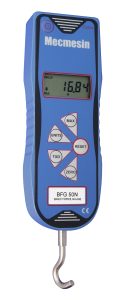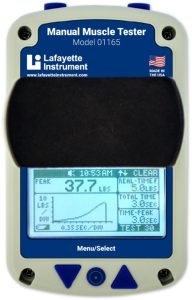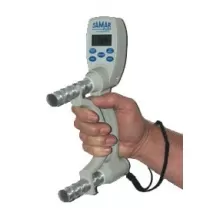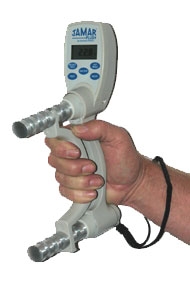
The Digital Pinch Gauge is a modern, electronic version of the traditional hydraulic pinch gauge, designed to accurately measure thumb and finger pinch strength. Compact, lightweight, and easy to use, it provides objective measurements for clinical assessment, rehabilitation, and strength evaluation applications.
Results can be displayed in either pounds (lb) or kilograms (kg) on a large, easy-to-read LCD screen. The simple push-button interface allows users to zero readings, recall stored results, and save measurements quickly and accurately.
The gauge can store up to 99 readings in its internal memory, making it ideal for tracking patient progress over time. Supplied with a wrist strap for added security and portability, the instrument is powered by a single 3V battery and is suitable for use in clinics, hospitals, rehabilitation centres, and research environments.
Typical Applications
- Hand therapy and rehabilitation
- Assessment of thumb and finger strength
- Evaluation of hand injuries and trauma
- Occupational therapy
- Post-surgical recovery monitoring
- Neurological assessment
- Functional capacity evaluations
- Clinical research and outcome studies
Key Features
- Measures thumb and finger pinch strength
- Displays results in kg or lb
- Easy-to-read LCD display
- Stores up to 99 measurements
- Simple push-button operation
- Zero and memory recall functions
- Lightweight design, weighing only 145 g
- Measurement range up to 25 kg (60 lb)
- Includes wrist strap and 3V battery
- Compact size: 25 × 13 × 5 cm
Digital Pinch Gauge vs Hand Grip Dynamometer
- The Digital Pinch Gauge measures pinch strength using the thumb and fingers.
- The Hand Grip Dynamometer measures overall grip strength of the hand and forearm.
Both instruments are commonly used together to provide a more complete assessment of hand function and rehabilitation progress.
The Digital Pinch Gauge is used to measure the strength of the thumb and fingers, providing objective data for clinical assessment, rehabilitation, and functional evaluation. It is particularly valuable when assessing fine motor function and hand strength that cannot be fully evaluated with a standard grip dynamometer.
Hand Therapy & Rehabilitation
Used to monitor recovery following:
- Hand and finger injuries
- Tendon repairs
- Fractures
- Nerve injuries
- Post-surgical rehabilitation
Occupational Therapy
Helps assess a patient’s ability to perform everyday tasks requiring pinch strength, such as:
- Writing
- Buttoning clothing
- Handling tools
- Grasping small objects
Thumb & Finger Strength Assessment
Measures common pinch functions including:
- Tip pinch (thumb to fingertip)
- Key pinch (thumb against the side of the index finger)
- Palmar pinch (three-point pinch)
Neurological Evaluation
Used to assess hand function in patients with:
- Stroke
- Multiple sclerosis
- Parkinson’s disease
- Peripheral nerve injuries
- Other neuromuscular disorders
Functional Capacity Evaluation
Provides objective strength measurements for:
- Workplace injury assessments
- Return-to-work programs
- Disability evaluations
- Functional performance testing
Sports Medicine
Useful for evaluating hand and finger strength in athletes involved in:
- Climbing
- Racquet sports
- Golf
- Baseball and cricket
- Martial arts
Clinical Research
Frequently used in studies involving:
- Hand function assessment
- Rehabilitation outcomes
- Muscle strength evaluation
- Age-related strength changes
Key Benefits
- Objective measurement of thumb and finger strength
- Tracks rehabilitation progress over time
- Identifies strength deficits and imbalances
- Supports clinical decision-making
- Stores multiple readings for comparison and reporting
- Portable and easy to use in clinical and field environments
Both the Digital Pinch Gauge and Hand-Held Dynamometer (HHD) are used to measure strength, but they are designed for different types of assessments and muscle groups.
| Feature | Digital Pinch Gauge | Hand-Held Dynamometer (HHD) |
|---|---|---|
| Primary Function | Measures thumb and finger pinch strength | Measures muscle strength throughout the body |
| Test Type | Pinch force | Push and pull muscle force |
| Muscle Groups Tested | Thumb, fingers, and hand muscles | Arms, shoulders, legs, hips, neck, and other muscle groups |
| Common Tests | Tip pinch, key pinch, and palmar pinch | Manual muscle testing and break-force testing |
| Measurement Range | Up to 25 kg (60 lb) | Up to 135 kg (300 lb / 1335 N) |
| Typical Users | Hand therapists, occupational therapists, physiotherapists | Physiotherapists, sports therapists, rehabilitation specialists, clinicians |
| Data Storage | Up to 99 readings | Up to 150 test results |
| Portability | Compact handheld unit | Portable handheld unit with interchangeable attachments |
Digital Pinch Gauge
The Digital Pinch Gauge is designed specifically to measure the strength of the thumb and fingers. It is most commonly used for:
- Hand injury assessment
- Occupational therapy
- Fine motor function evaluation
- Tendon and nerve rehabilitation
- Arthritis and hand dysfunction assessment
- Monitoring recovery following hand surgery
The gauge is particularly useful when assessing activities that rely on pinch strength, such as gripping keys, holding utensils, writing, or manipulating small objects.
Hand-Held Dynamometer (HHD)
The HHD is a more versatile device that measures the strength of major muscle groups throughout the body. Typical applications include:
- Manual muscle testing
- Sports medicine
- Neurological assessment
- Orthopaedic rehabilitation
- Functional capacity evaluations
- Return-to-work assessments
The HHD records peak force and break force, providing objective measurements of muscular strength beyond the hand and fingers.
Which Instrument Should You Choose?
- Choose a Digital Pinch Gauge when assessing thumb and finger strength, dexterity, and hand function.
- Choose a Hand-Held Dynamometer when measuring overall muscle strength in the upper and lower limbs or other body regions.
In many rehabilitation and therapy settings, both instruments are used together to provide a complete assessment of upper-limb function, with the Pinch Gauge evaluating fine hand strength and the HHD assessing larger muscle groups.
Choose S.I. Instruments for precision you can trust, compliance you can rely on, and service that delivers confidence.