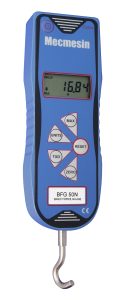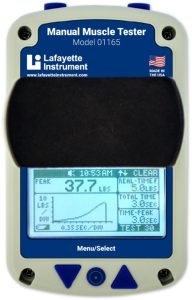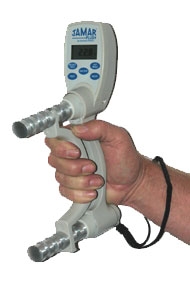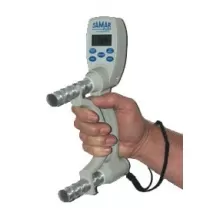
This Digital Hand Grip Dynamometer is ideal for the routine screening of grip strength and the initial and ongoing evaluation of patients with hand trauma, injury, or functional impairment. Designed for clinical accuracy and ease of use, it provides objective grip strength measurements for rehabilitation, assessment, and monitoring applications.
Constructed from durable aluminium with a scratch-resistant UV coating, the dynamometer is built to withstand everyday clinical use. The easy-to-read LCD display measures isometric grip force from 0 to 200 lb (90 kg) and can be configured to display results in either kilograms or pounds.
Advanced digital load cell technology ensures accurate and repeatable measurements, while Rapid Exchange Testing with audible signals allows efficient testing of multiple patients. For enhanced data analysis, the instrument automatically calculates the Average, Standard Deviation, and Coefficient of Variation for recorded tests.
The dynamometer features a two-minute auto-off function to conserve battery life, a low battery indicator, and is supplied complete with two AAA batteries and a reusable storage case.
Typical Applications
- Hand injury and trauma assessment
- Rehabilitation and physical therapy
- Occupational therapy
- Grip strength screening
- Functional capacity evaluations
- Sports medicine and athlete assessments
- Geriatric strength monitoring
- Clinical research and patient outcome tracking
Key Features
- Measures isometric grip force from 0 to 200 lb (90 kg)
- Displays results in kilograms or pounds
- Durable aluminium construction with UV-resistant coating
- Accurate digital load cell technology
- Rapid Exchange Testing with audible signals
- Automatically calculates:
- Average
- Standard Deviation
- Coefficient of Variation
- Easy-to-read LCD display
- Two-minute auto-off function
- Low battery indicator
- Includes two AAA batteries
- Supplied in a reusable storage container
The Digital Hand Grip Dynamometer is widely used to measure hand and forearm strength, providing objective and repeatable data for clinical, rehabilitation, occupational, and sports performance assessments.
Rehabilitation & Physical Therapy
Used to monitor recovery and rehabilitation following:
- Hand and wrist injuries
- Tendon and ligament damage
- Fractures
- Orthopaedic surgery
- Neurological conditions affecting hand function
Occupational Therapy
Helps therapists assess a patient’s ability to perform daily activities and track improvements in hand strength and functional independence.
Hand Trauma Evaluation
Ideal for the initial assessment and ongoing monitoring of patients with:
- Hand injuries
- Crush injuries
- Repetitive strain injuries
- Post-surgical recovery
Sports Medicine & Athletic Performance
Used to evaluate:
- Grip strength in athletes
- Hand and forearm conditioning
- Recovery from sports-related injuries
- Performance changes over time
Functional Capacity Evaluation (FCE)
Provides objective grip strength measurements for:
- Workplace injury assessments
- Return-to-work programs
- Occupational health evaluations
- Physical capability testing
Geriatric Assessment
Useful for monitoring:
- Age-related muscle decline
- General strength and mobility
- Functional independence
- Fall and frailty risk assessments
Clinical Research
Often used in research and healthcare studies where reliable measurement of hand strength is required for patient evaluation and outcome tracking.
Key Benefits
- Objective measurement of grip strength
- Tracks patient progress over time
- Fast and easy testing procedure
- Suitable for a wide range of age groups and conditions
- Automatic calculation of averages and statistical data
- Ideal for clinical, rehabilitation, occupational, and sports applications
Both instruments measure force, but they are designed for different clinical purposes and testing methods.
| Feature | Digital Hand Grip Dynamometer | Hand-Held Dynamometer (HHD) |
|---|---|---|
| Primary Function | Measures grip strength | Measures muscle strength throughout the body |
| Test Type | Hand grip force only | Push or pull force in specific muscle groups |
| Measurement | Up to 200 lb (90 kg) | Up to 135 kg (300 lb / 1335 N) |
| Applications | Hand therapy, grip assessment, rehabilitation | Manual muscle testing, physiotherapy, sports medicine, rehabilitation |
| Portability | Compact handheld device | Portable handheld device with interchangeable attachments |
| Patient | Patient squeezes the handle | Clinician applies force to overcome patient resistance |
| Muscle Groups Tested | Hand and forearm muscles | Arms, legs, shoulders, hips, neck, and other muscle groups |
| Data Analysis | Average, Standard Deviation, Coefficient of Variation | Peak force, break force, test duration, stored test data |
| Typical Users | Occupational therapists, hand therapists, physiotherapists | Physiotherapists, sports therapists, rehabilitation specialists, clinicians |
Digital Hand Grip Dynamometer
The Digital Hand Grip Dynamometer is specifically designed to measure grip strength and hand function. It is commonly used for:
- Hand injury rehabilitation
- Occupational therapy
- Grip strength screening
- Arthritis assessment
- Sports performance evaluation
- Functional capacity assessments
Its straightforward operation and statistical analysis functions make it ideal for monitoring hand strength improvements over time.
Hand-Held Dynamometer (HHD)
The HHD is a more versatile instrument designed to measure strength in multiple muscle groups throughout the body. It is commonly used for:
- Manual muscle testing
- Neurological assessments
- Sports rehabilitation
- Orthopaedic evaluations
- Return-to-work assessments
- Clinical research
The HHD evaluates a patient’s ability to resist force and provides objective measurements of muscle strength beyond the hand and forearm.
Which Instrument Should You Choose?
- Choose a Digital Hand Grip Dynamometer if your primary focus is assessing hand and grip strength.
- Choose a Hand-Held Dynamometer (HHD) if you need to evaluate overall muscle strength across multiple body regions and muscle groups.
Many rehabilitation and physiotherapy clinics use both instruments together, with the grip dynamometer assessing hand function and the HHD providing a broader evaluation of muscular strength and recovery.
Choose S.I. Instruments for precision you can trust, compliance you can rely on, and service that delivers confidence.