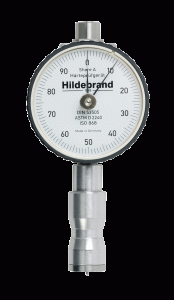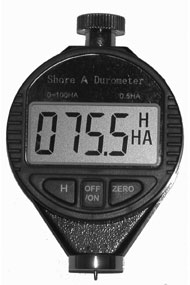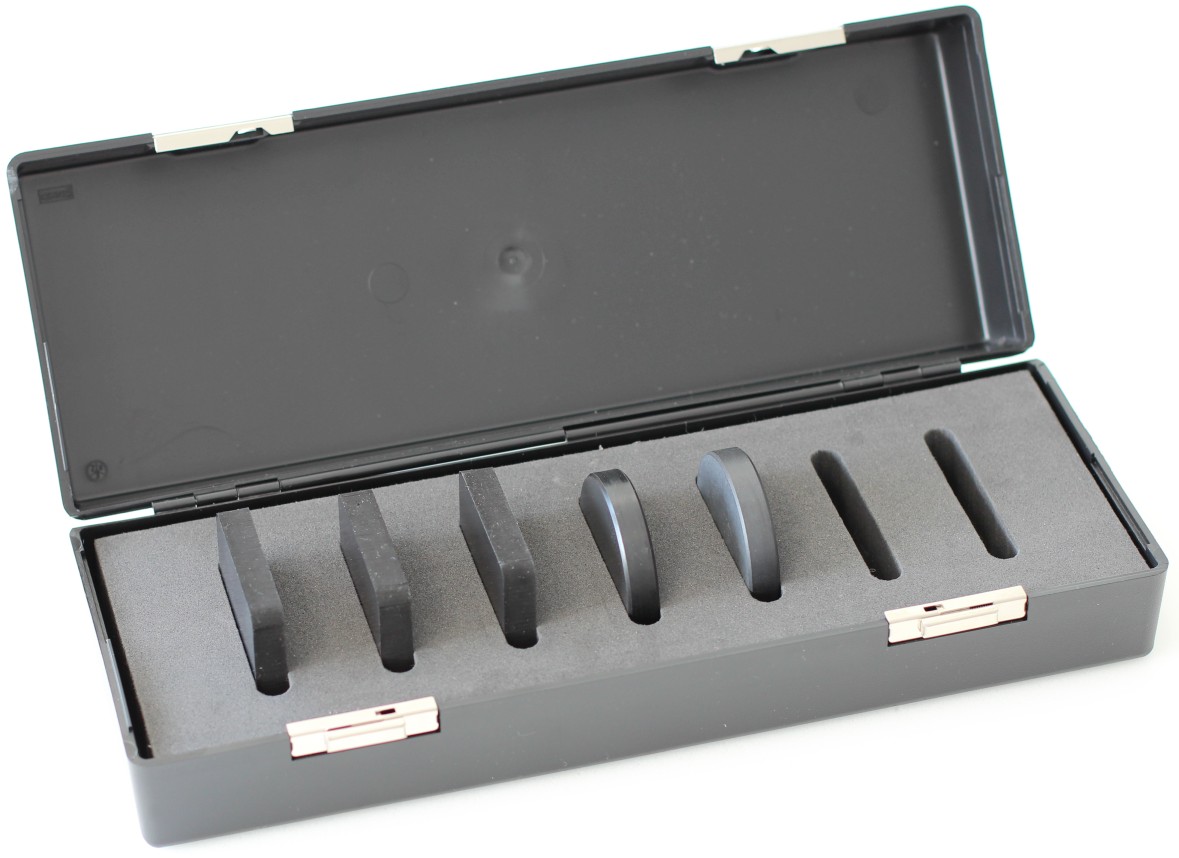
Shore D Comparison Blocks are designed for use as reference standards and comparison samples for Type D Durometers. They provide a quick and convenient method of verifying instrument performance and checking measurement consistency before testing.
The set includes five test blocks covering a broad hardness range, allowing users to compare readings across commonly encountered Shore D values. These blocks are ideal for routine verification, operator training, quality assurance, and general durometer performance checks.
Each set is supplied with an in-house calibration certificate, providing confidence in the accuracy and traceability of the reference values.
Available Hardness Values
- Approximately 10 Shore D
- Approximately 20 Shore D
- Approximately 40 Shore D
- Approximately 65 Shore D
- Approximately 90 Shore D
Typical Applications
- Verification of Type D durometer performance
- Reference checks prior to testing
- Quality control inspections
- Laboratory and production environments
- Operator training and measurement consistency check
Key Features
- Designed for Shore D hardness scale applications
- Suitable for use with Type D Durometers
- Five hardness reference blocks included
- Wide hardness range from approximately 10 to 90 Shore D
- Ideal for comparison and instrument verification
- Supplied with an in-house calibration certificate
- Durable and easy to use
Hardness scales are used to measure a material’s resistance to indentation. The most appropriate scale depends on the material being tested and its hardness range.
Shore A vs Shore D
The Shore A and Shore D scales are the most common durometer scales for elastomers and plastics.
| Scale | Typical Materials | Hardness Range |
|---|---|---|
| Shore A | Soft rubbers, elastomers, silicones, neoprene | Soft to medium-hard |
| Shore D | Hard rubber, rigid plastics, thermoplastics | Medium-hard to very hard |
Examples:
- Rubber bands, soft seals, and flexible gaskets are typically measured using Shore A.
- Hard hats, PVC pipe, nylon components, and rigid polyurethane are often measured using Shore D.
As a general guide:
- A material measuring 95 Shore A may be better evaluated using Shore D because it has become too hard for the Shore A scale to provide sufficient resolution.
- Shore D is designed with a sharper indenter and stronger spring force to measure harder materials accurately.
Choose Shore D when testing:
- Rigid plastics
- Hard rubber compounds
- Thermoplastics
- Polycarbonate
- Acrylic materials
- Nylon components
- Hard polyurethane
For softer materials such as seals, flexible rubber, and silicone products, Shore A is usually the preferred scale.
Using Shore D Comparison Blocks
Shore D comparison blocks are primarily used to:
- Verify durometer performance
- Check instrument consistency
- Train operators
- Compare readings before testing production samples
A reading close to the certified value of the comparison block indicates that the durometer is functioning correctly and producing consistent results.
Choose S.I. Instruments for precision you can trust, compliance you can rely on, and service that delivers confidence.