Small Bone Caliper
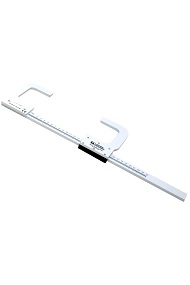
The Small Bone Caliper is a precision anthropometric measuring instrument designed for accurate measurement of smaller skeletal dimensions and muscle widths. With a measuring range of 0 to 30 cm and graduations of 0.1 cm, it is ideal for body measurement studies, growth assessments, sports science, and clinical evaluations.
Constructed from lightweight, durable aluminium, the caliper incorporates a spring-loaded ball bearing within a sliding C-shaped arm to ensure smooth operation and consistent measurement pressure. This design provides accurate, repeatable results for a wide range of anthropometric applications.
Typical Applications
- Wrist breadth measurements
- Elbow breadth measurements
- Knee breadth measurements
- Ankle breadth measurements
- Bicep width measurements
- Calf width measurements
- Anthropometric assessments
- Growth and development studies
- Sports science and athlete profiling
- Ergonomic and biomechanical research
Typical Users
Anthropometrists
Used to measure skeletal breadths and body dimensions for population studies and body composition assessments.
Sports Scientists
Supports athlete profiling, body structure assessment, and performance research.
Researchers & Academics
Widely used in anthropometric, biomechanical, and human growth studies conducted in universities and research institutions.
Physiotherapists & Rehabilitation Professionals
Useful for documenting body dimensions and monitoring physical changes during rehabilitation programs.
Paediatricians & Child Development Specialists
Assists in tracking skeletal growth and development in children and adolescents.
Ergonomists
Used to collect body dimension data for workplace, equipment, and product design.
Common Measurements
- Bicondylar humerus breadth (elbow width)
- Bicondylar femur breadth (knee width)
- Wrist breadth
- Ankle breadth
- Bicep diameter
- Calf diameter
- Other small body and skeletal dimensions
Key Features
- Measurement range: 0 to 30 cm
- Resolution: 0.1 cm
- Lightweight aluminium construction
- Spring-loaded ball bearing mechanism
- Sliding C-shaped arm design
- Accurate and repeatable measurements
- Easy-to-use portable design
- Suitable for clinical, educational, and research applications
Benefits
- Accurate measurement of small skeletal dimensions
- Ideal for anthropometric and body composition studies
- Supports growth, development, and rehabilitation assessments
- Reliable and repeatable measurement performance
- Durable construction for professional use
Measurement Techniques for Wrist and Elbow Width Using a Small Bone Caliper
Accurate wrist and elbow breadth measurements are commonly used in anthropometry, body composition assessment, sports science, and growth studies. Consistent landmark identification and subject positioning are essential for reliable results.
Wrist Width (Bistyloid Breadth)
Purpose: Measures the width of the wrist across the bony prominences.
Measurement Technique
- Ask the subject to sit or stand with the forearm relaxed and the palm facing down.
- Locate the styloid processes of the radius and ulna on either side of the wrist.
- Position the caliper tips directly over these bony landmarks.
- Apply light, consistent pressure without compressing surrounding tissue.
- Read and record the measurement to the nearest 0.1 cm.
Typical Applications
- Body frame size assessment
- Anthropometric profiling
- Growth and development studies
- Sports science evaluations
Elbow Width (Bicondylar Humerus Breadth)
Purpose: Measures the distance between the medial and lateral epicondyles of the humerus.
Measurement Technique
- Ask the subject to flex the elbow to approximately 90 degrees.
- Locate the bony prominences on either side of the elbow:
- Medial epicondyle
- Lateral epicondyle
- Position the caliper tips on the outermost points of these landmarks.
- Ensure the caliper is perpendicular to the long axis of the upper arm.
- Apply gentle pressure and record the measurement to the nearest 0.1 cm.
Typical Applications
- Skeletal frame assessment
- Anthropometric studies
- Body composition calculations
- Athlete profiling and talent identification
Best Practice Tips
✅ Use clearly identifiable bony landmarks
✅ Keep the subject in a consistent position
✅ Apply gentle, uniform pressure
✅ Take at least two measurements and average if required
✅ Measure on the same side of the body for repeat assessments
✅ Record measurements immediately
Common Errors to Avoid
❌ Measuring over soft tissue instead of bone
❌ Excessive pressure with the caliper
❌ Incorrect elbow position during elbow breadth measurements
❌ Tilting the caliper during measurement
❌ Inconsistent landmark selection between assessments
Accurate wrist and elbow breadth measurements provide valuable data for anthropometric analysis, growth monitoring, ergonomic design, and sports science research.
Choose S.I. Instruments for precision you can trust, compliance you can rely on, and service that delivers confidence.